
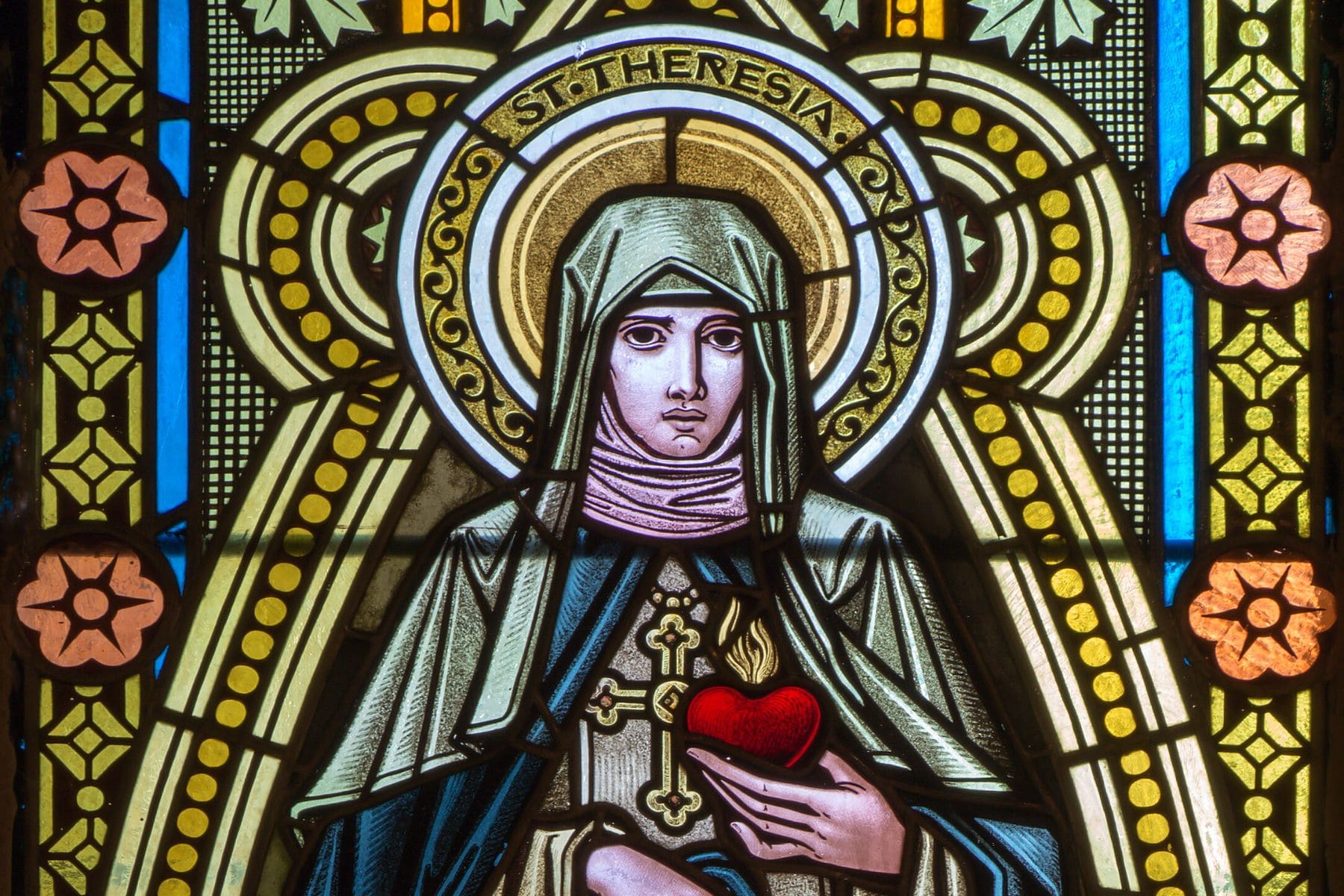
In this article, Father Réjean Lessard, rector of the diocesan shrine of St. Thérèse of the Child Jesus, shares with us the highlights of the life story of Saint Thérèse of Lisieux.Dans cet article, l’abbé Réjean Lessard, recteur du sanctuaire diocésain de Ste-Thérèse-de-l’Enfant-Jésus, nous partage les points marquants de l’histoire de sainte Thérèse de Lisieux.
"Story of a Soul" – The Spiritual Legacy of Saint Thérèse of Lisieux
One year after the death of Saint Thérèse of the Child Jesus, the prioress of the Carmel published a circular about her writings, which she entitled “Story of a Soul”. Many readers discovered in it a new way of living spirituality.
Thérèse often quoted passages from the Word of God. The foundation of her writings was rooted in the Merciful Love of the Father. Many times, she referred to the parable of the Prodigal Son: the father welcoming back his child who had abruptly left the family home, and the father welcoming the elder son who grew angry at his father’s joy in receiving his brother.
Here is an excerpt from her writings:
«Yes, I feel it; even if I had on my conscience all the sins one could possibly commit, I would, heart broken with sorrow, go and throw myself into the arms of Jesus, for I know how much He loves the prodigal child who returns to Him.» MS C.
When this circular was read in the early 1900s, several thousand pilgrims went to the cemetery in Lisieux to pray there, asking for favors and healings.
Today, “Story of a Soul” has been translated into 50 languages, and thousands of pilgrims still travel to Lisieux for spiritual renewal.
The Family of Saint Thérèse of Lisieux
We might wonder: how did Thérèse, in such a short life (1873–1897), come to fully grasp the Gospel message?
First of all, she was born into a deeply Christian environment, sensitive to religious values. Her father, Louis Martin, and her mother, Zélie Guérin, had both wanted to enter religious life, but the superiors of their communities encouraged them to remain in the secular world.
They met, married in Alençon, and had nine children, four of whom died at a young age. It was a painful marital and parental trial, but they entrusted their deceased children to God, believing they became angels watching over the family.
The parents were devoted to daily Mass, praying the Rosary, visiting churches, attending Holy Hours, and making sacrifices during Lent. They were also professionally, socially, and communally engaged. Mr. Martin was a watchmaker, and Mrs. Guérin ran a lace-making business with 25 employees.
A tragic event struck the family: the death of Mrs. Zélie Guérin at age 46. Mr. Martin was left with five daughters. He moved to Lisieux to be near his brother-in-law and sister-in-law.
Over time, two of Thérèse’s sisters, Marie and Pauline, entered the Carmel of Lisieux, while Léonie entered the Visitation convent in Caen.
Louis Martin and Zélie Guérin were beatified in Lisieux in 2008 and canonized in Rome in 2015. Their reliquary now rests in the Basilica of Lisieux.
Thérèse’s Entrance into the Carmel
At age 15, Thérèse wanted to enter the Carmel. She asked her father on Pentecost Sunday, May 29, 1887, after returning home from Mass at Les Buissonnets. Special steps and permissions were required for her to be admitted.
When Thérèse met the prioress of the Carmel, she was asked to write down her reasons for entering. She gave two:
- I want to enter the Carmel to save souls;
- And above all, to pray for priests.
The first reason was shaped by her life experience. In spring 1887, Henri Pranzini committed a triple murder in Paris. He was condemned to the guillotine in August of that year. Mr. Martin received *La Croix* newspaper, and Thérèse read about the case. She began praying for the condemned man, even though he refused to see the prison chaplain.
On August 31, before the crowd of nearly 2,000 gathered to watch his execution in Paris, Pranzini, accompanied by guards and the chaplain, stopped at the foot of the scaffold and kissed the crucifix three times.
The next day, La Croix reported the incident. Thérèse, who had prayed for him and even offered a Mass for his conversion, saw this as a sign of repentance and of the Father’s merciful welcome.
The second reason came from another experience.
In 1887, Pope Leo XIII celebrated his 50th priestly anniversary, and a pilgrimage was organized from Paris. Mr. Martin and his daughters Thérèse and Céline joined. Before the pilgrimage, they spent several days in Paris, often visiting Notre-Dame des Victoires Basilica.
The pilgrimage, from November 4 to December 2, included 197 French pilgrims, 75 of whom were priests. Thérèse observed that priests were neither angels nor saints; in casual settings, their conversations were not always edifying. She realized that priests were human, weak, and in need of prayer—something she could offer in the Carmel.
Thérèse entered the Carmel of Lisieux in April 1888. She died on September 30, 1897, saying, “I am not dying; I am entering into life” and “I will spend my Heaven doing good on earth.”
The Path of Saint Thérèse of Lisieux to Holiness
Thérèse lived with the burning desire to become a saint and to rest in God’s embrace. In Letter 197 to her sister Marie of the Sacred Heart, she wrote: “What pleases Him is to see me love my littleness and my poverty—it is the blind hope I have in His mercy. That is my only treasure.”
Her spiritual journey at the Carmel allowed her to love what made her small and poor. Christ meets us in our limitations. She accepted being carried in the arms of Jesus, always aware of the gap between the call to holiness and her own weakness.
From April 1896 to April 1897, Thérèse experienced the “night of faith”—a dryness in her spiritual life. Prayer was distracted, she dozed during adoration, and Mass left her cold. Yet despite doubts, she continued to trust in God’s merciful love.
Her life was founded on the rock of God’s mercy. Declared a Doctor of the Church in 1997 without any formal academic degree, her “Little Way” remains a path for all ages and times.
The Great Reliquary of Saint Thérèse of Lisieux in Canada
In 2001, the Great Reliquary of Saint Thérèse of the Child Jesus and the Holy Face spent four months in Canada. Thousands of pilgrims came to pray, seek her intercession, and leave intentions.
One memorable event took place at the diocesan shrine of St. Thérèse in Beauport, Quebec, in late November 2001:
At about 3 a.m. one night, a police officer entered, wondering what was happening inside. The person at the reception told him: “Do what the others are doing: get in line and touch the reliquary.”
The officer did so, then left. A few minutes later, he returned and said, *“I don’t know what’s happening inside me.”* The greeter suggested he speak to the priest in the confessional. The officer went in—with his service revolver—and stayed for an hour.
When he came out, his face was radiant with joy. Thérèse invites us to experience the merciful love of the Father.
In May 2025, the shrine will again receive the Great Reliquary of Saint Thérèse for the 100th anniversary of her canonization. She was beatified in 1923.
Thérèse wrote: “When I die, I will let fall a shower of roses from heaven.”
By Father Réjean Lessard
Note: Discover our upcoming pilgrimages to France (click here), as well as upcoming trips accompanied by Father Réjean Lessard (click here).